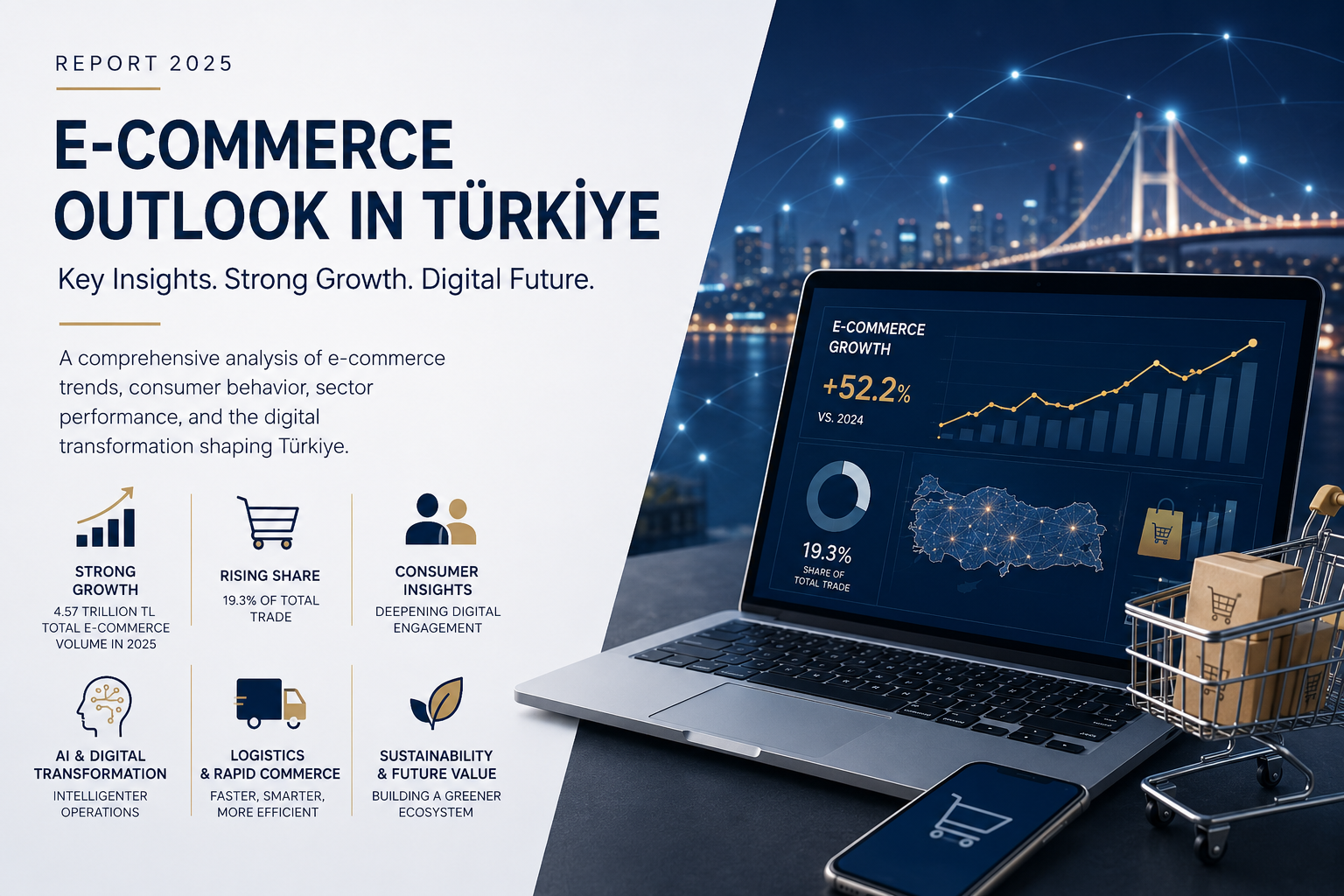
The year 2025 marks a historic turning point in Türkiye’s economic history, representing the moment when digitalization ceased to be a supplementary component of economic activity and emerged as a principal driver of economic growth. The E-Commerce Outlook in Türkiye Report 2025 (the “Report”), published by the Ministry of Trade of the Republic of Türkiye on 12 May 2026, clearly demonstrates that this remarkable expansion reflects not merely numerical growth but also a profound structural transformation.
The Turkish e-commerce ecosystem reaffirmed its strategic significance by reaching a record transaction volume of TRY 4.57 trillion, representing a 52.2% increase compared to the previous year. The rise in e-commerce’s share of total trade to 19.3% constitutes one of the clearest indicators that consumer behavior has undergone a lasting shift towards digital channels.
The Report addresses all structural dimensions of the ecosystem, ranging from artificial intelligence integration and logistics optimization to sustainable commerce models and evolving consumer demographics. By analyzing cross-sectoral interactions through econometric models, the Report provides a data-driven roadmap for businesses, investors, and market participants seeking to position themselves within the future landscape of commerce.
The principal findings of the Report, prepared to assess the key pillars of this sectoral transformation, are summarized below.
KEY HIGHLIGHTS OF THE REPORT
Macroeconomic Outlook and Strategic Growth
The e-commerce ecosystem in Türkiye continued to occupy a central position within the national economy throughout 2025.
Total e-commerce volume reached TRY 4.57 trillion in 2025, representing a 52.2% increase compared to the previous year. Retail e-commerce volume amounted to TRY 2.46 trillion, reflecting year-on-year growth of 51.8%. The total number of e-commerce transactions also increased on an annual basis, reaching 5.94 billion transactions.
E-commerce volume increased from USD 23.94 billion in 2019 to USD 115.43 billion in 2025. Between 2019 and 2025, the compound annual growth rate of e-commerce volume in U.S. dollar terms stood at 30%.
In 2025, e-commerce accounted for 6.9% of Türkiye’s Gross Domestic Product (“GDP”), while its share of total trade reached 19.3%. Monthly analysis indicates that this ratio stood at 22.4% in January, 21.4% in February and 21.8% in March, before stabilizing within the 17–18% range during the summer months. Driven by promotional campaigns, the ratio increased once again to 22.4% in November, whereas consumer spending through e-commerce channels declined in December.
Card-based payments maintained their leading position with a share of 62.5%, followed by bank transfers/EFT transactions at 29.2%. The 3D Secure authentication protocol was utilized in 64.1% of all card-based transactions.
Consumer Demographics and Behavioral Analysis
The profile of e-commerce users reveals significant concentrations across both age and gender segments.
Women accounted for 56% of marketplace-based e-commerce expenditure by value and 74.6% of the total transaction count.
The most active consumer segment consisted of individuals aged 25–34. Female consumers aged 25–29 recorded the highest spending ratio at 82.3%, whereas male consumers within the same age group represented only 17.7%.
Gender distribution varies considerably across sectors. Female consumers dominate the apparel (82.7%), cosmetics (80.4%) and mother-and-baby (78.7%) categories, whereas male consumers are particularly prominent in software (91.1%), automotive spare parts (61.1%) and electronics (50.9%).
Sectoral Performance and Operational Metrics
Sector-specific e-commerce volumes, average basket values and return rates provide important insights into the operational depth of the ecosystem.
With a transaction volume of TRY 428.7 billion, the Apparel, Footwear and Accessories sector ranked first among all sectors. It was followed by Electronics (TRY 304.3 billion), Airlines (TRY 285.4 billion) and Food Delivery Services (TRY 270.16 billion).
The highest average basket value was recorded in the White Goods sector at TRY 10,513. By comparison, the average basket value in the grocery and supermarket category stood at TRY 889.
The highest cancellation and return rate was observed in the Apparel, Footwear and Accessories sector at 21.6%, whereas the lowest rate was recorded in the Medical Products, Personal Care and Cosmetics sector at 3.2%.
E-commerce’s share of total trade peaked at 26.6% on Saturdays and reached 58.7% during overnight hours (00:00–06:00).
The ratio of sector-specific e-commerce activity to total trade is presented below (Table 1):
Sector
E-Commerce Share of Total Trade
Electronics
38.6%
Grocery and Supermarket
5%
Apparel, Footwear and Accessories
25.4%
Sports and Outdoor
35.7%
Food Delivery Services
12.6%
White Goods and Small Household Appliances
35.3%
Significant increases in transaction volumes were observed during November and December, whereas notable declines occurred particularly towards the end of March and in June. In November 2025, e-commerce volume increased by 41.5% compared to the corresponding period in 2024. During the same period, the number of products and services sold rose by 11.6%.
Rapid Commerce and Private-Label Products
Consumers’ increasing demand for speed continues to drive the emergence and expansion of new business models. In this context, rapid commerce has become one of the most prominent e-commerce models, effectively responding to such expectations by ensuring the delivery of ordered products to consumers within exceptionally short timeframes.
In 2025, the rapid commerce market volume reached TRY 388.7 billion, representing a 55.6% increase compared to the previous year. Rapid commerce accounted for 8.5% of total e-commerce volume during the same period.
Within the grocery and supermarket sector, “traditional e-commerce” (delivery via courier services) represented 46.6% of transactions, while “instant delivery” and “scheduled delivery” accounted for 29.2% and 24.2%, respectively.
İstanbul generated 55.4% of the total rapid commerce volume, followed by Ankara, İzmir, Bursa and Antalya, respectively.
According to data published through ETBİS, private-label products accounted for 13.4% of the total quantity of goods sold through e-commerce transactions conducted by grocery and supermarket service providers.
Technological Transformation: Artificial Intelligence and Digital Security
The digital capabilities of businesses are increasingly being shaped by the adoption of artificial intelligence technologies.
A total of 47.9% of businesses reported using artificial intelligence at a basic level. While the proportion of businesses employing advanced AI solutions stands at 7%, 25.4% indicated that they have not yet adopted artificial intelligence technologies.
The most prevalent use case is the generation of product descriptions and visual content, reported by 83.4% of businesses. AI-powered customer support through chatbots, by contrast, is utilized by 24% of businesses.
An assessment of the barriers limiting AI adoption reveals that the most significant obstacles are legal uncertainties (70.3%) and data privacy concerns (70.2%).
Approximately 62% of businesses employ strong password policies and multi-factor authentication (MFA) mechanisms.
While 19.1% of businesses engage in collaborations with social media influencers, 26.9% reported that they do not utilize social media platforms at all.
Sustainability and the Second-Hand Market
Environmentally conscious consumption patterns are increasingly generating economic value within the e-commerce ecosystem.
In 2025, sustainable e-commerce volume reached TRY 21.8 billion, while the total number of transactions amounted to 23.6 million. The Apparel, Footwear and Accessories sector ranked first both in terms of transaction volume and number of units sold.
Mobile phones continue to dominate the refurbished products market. In particular, 128 GB devices released in 2021 held the largest market share, accounting for 16.3% of total volume.
The most widely adopted sustainability practice among businesses is the reduction of paper consumption through digitalization, reported by 71.7% of respondents. Environmentally friendly packaging and recycling initiatives rank second, with an adoption rate of 63.6%.
Logistics and Regional Dynamics
Türkiye’s logistics infrastructure continues to improve, while İstanbul maintains its position as the central hub of the e-commerce ecosystem.
In 2025, the average parcel delivery time nationwide declined to 42.2 hours. A total of 53.1% of shipments were delivered within 24 to 48 hours.
İstanbul accounted for 53.5% of all parcel dispatches nationwide and received 27.9% of total deliveries.
To measure provincial levels of e-commerce integration, the Report introduces a province-based E-Commerce Adaptation Index. According to the Index, İstanbul, Çorum, Kayseri, Kocaeli and Ankara ranked as the five provinces most effectively integrated into the e-commerce ecosystem.
Businesses and Marketplace Practices
As of 2025, the number of active businesses engaged in e-commerce activities increased to 634,611.
Of all businesses operating in the e-commerce sector, 75% are sole proprietorships, 21% are limited liability companies and 4% are joint-stock companies.
The sector with the highest concentration of businesses is Food Services, accounting for 20.3% of all e-commerce enterprises. This is followed by Apparel, Footwear and Accessories (13.8%), Electronics (11.9%), and Home, Garden, Furniture and Decoration (10.5%).
A significant majority of businesses (79.2%) prefer to sell through a single online marketplace. The proportion of businesses operating across two marketplaces stands at 13.7%.
The data further indicates that 78% of businesses operate under a “vertical” model, focusing on a single sector, whereas 22% follow a “horizontal” model, with transaction volumes distributed more evenly across multiple sectors.
Econometric Interactions
In this section, the Report analyses the transmission of sectoral shocks through econometric modelling techniques.
Developments within the accommodation sector exert both immediate and persistent leading effects on the travel, airline, food services and vehicle rental sectors.
Demand for education and consultancy services explains 54.61% of the variance observed within the electronics sector.
Shocks affecting the agriculture and livestock sectors are transmitted to the grocery and supermarket segment through a progressively strengthening lagged effect, reaching an impact level of 56.46% by the twelfth month. This finding indicates that agricultural supply-side shocks are reflected in the retail sector with a measurable time lag.
INTRODUCTION
The year 2025 marks a historic turning point in Türkiye’s economic history, representing the moment when digitalization ceased to be a supplementary component of economic activity and emerged as a principal driver of economic growth. The E-Commerce Outlook in Türkiye Report 2025 (the “Report”), published by the Ministry of Trade of the Republic of Türkiye on 12 May 2026, clearly demonstrates that this remarkable expansion reflects not merely numerical growth but also a profound structural transformation.
The Turkish e-commerce ecosystem reaffirmed its strategic significance by reaching a record transaction volume of TRY 4.57 trillion, representing a 52.2% increase compared to the previous year. The rise in e-commerce’s share of total trade to 19.3% constitutes one of the clearest indicators that consumer behavior has undergone a lasting shift towards digital channels.
The Report addresses all structural dimensions of the ecosystem, ranging from artificial intelligence integration and logistics optimization to sustainable commerce models and evolving consumer demographics. By analyzing cross-sectoral interactions through econometric models, the Report provides a data-driven roadmap for businesses, investors, and market participants seeking to position themselves within the future landscape of commerce.
The principal findings of the Report, prepared to assess the key pillars of this sectoral transformation, are summarized below.
KEY HIGHLIGHTS OF THE REPORT
Macroeconomic Outlook and Strategic Growth
The e-commerce ecosystem in Türkiye continued to occupy a central position within the national economy throughout 2025.
Total e-commerce volume reached TRY 4.57 trillion in 2025, representing a 52.2% increase compared to the previous year. Retail e-commerce volume amounted to TRY 2.46 trillion, reflecting year-on-year growth of 51.8%. The total number of e-commerce transactions also increased on an annual basis, reaching 5.94 billion transactions.
E-commerce volume increased from USD 23.94 billion in 2019 to USD 115.43 billion in 2025. Between 2019 and 2025, the compound annual growth rate of e-commerce volume in U.S. dollar terms stood at 30%.
In 2025, e-commerce accounted for 6.9% of Türkiye’s Gross Domestic Product (“GDP”), while its share of total trade reached 19.3%. Monthly analysis indicates that this ratio stood at 22.4% in January, 21.4% in February and 21.8% in March, before stabilizing within the 17–18% range during the summer months. Driven by promotional campaigns, the ratio increased once again to 22.4% in November, whereas consumer spending through e-commerce channels declined in December.
Card-based payments maintained their leading position with a share of 62.5%, followed by bank transfers/EFT transactions at 29.2%. The 3D Secure authentication protocol was utilized in 64.1% of all card-based transactions.
Consumer Demographics and Behavioral Analysis
The profile of e-commerce users reveals significant concentrations across both age and gender segments.
Women accounted for 56% of marketplace-based e-commerce expenditure by value and 74.6% of the total transaction count.
The most active consumer segment consisted of individuals aged 25–34. Female consumers aged 25–29 recorded the highest spending ratio at 82.3%, whereas male consumers within the same age group represented only 17.7%.
Gender distribution varies considerably across sectors. Female consumers dominate the apparel (82.7%), cosmetics (80.4%) and mother-and-baby (78.7%) categories, whereas male consumers are particularly prominent in software (91.1%), automotive spare parts (61.1%) and electronics (50.9%).
Sectoral Performance and Operational Metrics
Sector-specific e-commerce volumes, average basket values and return rates provide important insights into the operational depth of the ecosystem.
With a transaction volume of TRY 428.7 billion, the Apparel, Footwear and Accessories sector ranked first among all sectors. It was followed by Electronics (TRY 304.3 billion), Airlines (TRY 285.4 billion) and Food Delivery Services (TRY 270.16 billion).
The highest average basket value was recorded in the White Goods sector at TRY 10,513. By comparison, the average basket value in the grocery and supermarket category stood at TRY 889.
The highest cancellation and return rate was observed in the Apparel, Footwear and Accessories sector at 21.6%, whereas the lowest rate was recorded in the Medical Products, Personal Care and Cosmetics sector at 3.2%.
E-commerce’s share of total trade peaked at 26.6% on Saturdays and reached 58.7% during overnight hours (00:00–06:00).
The ratio of sector-specific e-commerce activity to total trade is presented below (Table 1):
Sector
E-Commerce Share of Total Trade
Electronics
38.6%
Grocery and Supermarket
5%
Apparel, Footwear and Accessories
25.4%
Sports and Outdoor
35.7%
Food Delivery Services
12.6%
White Goods and Small Household Appliances
35.3%
Significant increases in transaction volumes were observed during November and December, whereas notable declines occurred particularly towards the end of March and in June. In November 2025, e-commerce volume increased by 41.5% compared to the corresponding period in 2024. During the same period, the number of products and services sold rose by 11.6%.
Rapid Commerce and Private-Label Products
Consumers’ increasing demand for speed continues to drive the emergence and expansion of new business models. In this context, rapid commerce has become one of the most prominent e-commerce models, effectively responding to such expectations by ensuring the delivery of ordered products to consumers within exceptionally short timeframes.
In 2025, the rapid commerce market volume reached TRY 388.7 billion, representing a 55.6% increase compared to the previous year. Rapid commerce accounted for 8.5% of total e-commerce volume during the same period.
Within the grocery and supermarket sector, “traditional e-commerce” (delivery via courier services) represented 46.6% of transactions, while “instant delivery” and “scheduled delivery” accounted for 29.2% and 24.2%, respectively.
İstanbul generated 55.4% of the total rapid commerce volume, followed by Ankara, İzmir, Bursa and Antalya, respectively.
According to data published through ETBİS, private-label products accounted for 13.4% of the total quantity of goods sold through e-commerce transactions conducted by grocery and supermarket service providers.
Technological Transformation: Artificial Intelligence and Digital Security
The digital capabilities of businesses are increasingly being shaped by the adoption of artificial intelligence technologies.
A total of 47.9% of businesses reported using artificial intelligence at a basic level. While the proportion of businesses employing advanced AI solutions stands at 7%, 25.4% indicated that they have not yet adopted artificial intelligence technologies.
The most prevalent use case is the generation of product descriptions and visual content, reported by 83.4% of businesses. AI-powered customer support through chatbots, by contrast, is utilized by 24% of businesses.
An assessment of the barriers limiting AI adoption reveals that the most significant obstacles are legal uncertainties (70.3%) and data privacy concerns (70.2%).
Approximately 62% of businesses employ strong password policies and multi-factor authentication (MFA) mechanisms.
While 19.1% of businesses engage in collaborations with social media influencers, 26.9% reported that they do not utilize social media platforms at all.
Sustainability and the Second-Hand Market
Environmentally conscious consumption patterns are increasingly generating economic value within the e-commerce ecosystem.
In 2025, sustainable e-commerce volume reached TRY 21.8 billion, while the total number of transactions amounted to 23.6 million. The Apparel, Footwear and Accessories sector ranked first both in terms of transaction volume and number of units sold.
Mobile phones continue to dominate the refurbished products market. In particular, 128 GB devices released in 2021 held the largest market share, accounting for 16.3% of total volume.
The most widely adopted sustainability practice among businesses is the reduction of paper consumption through digitalization, reported by 71.7% of respondents. Environmentally friendly packaging and recycling initiatives rank second, with an adoption rate of 63.6%.
Logistics and Regional Dynamics
Türkiye’s logistics infrastructure continues to improve, while İstanbul maintains its position as the central hub of the e-commerce ecosystem.
In 2025, the average parcel delivery time nationwide declined to 42.2 hours. A total of 53.1% of shipments were delivered within 24 to 48 hours.
İstanbul accounted for 53.5% of all parcel dispatches nationwide and received 27.9% of total deliveries.
To measure provincial levels of e-commerce integration, the Report introduces a province-based E-Commerce Adaptation Index. According to the Index, İstanbul, Çorum, Kayseri, Kocaeli and Ankara ranked as the five provinces most effectively integrated into the e-commerce ecosystem.
Businesses and Marketplace Practices
As of 2025, the number of active businesses engaged in e-commerce activities increased to 634,611.
Of all businesses operating in the e-commerce sector, 75% are sole proprietorships, 21% are limited liability companies and 4% are joint-stock companies.
The sector with the highest concentration of businesses is Food Services, accounting for 20.3% of all e-commerce enterprises. This is followed by Apparel, Footwear and Accessories (13.8%), Electronics (11.9%), and Home, Garden, Furniture and Decoration (10.5%).
A significant majority of businesses (79.2%) prefer to sell through a single online marketplace. The proportion of businesses operating across two marketplaces stands at 13.7%.
The data further indicates that 78% of businesses operate under a “vertical” model, focusing on a single sector, whereas 22% follow a “horizontal” model, with transaction volumes distributed more evenly across multiple sectors.
Econometric Interactions
In this section, the Report analyses the transmission of sectoral shocks through econometric modelling techniques.
Developments within the accommodation sector exert both immediate and persistent leading effects on the travel, airline, food services and vehicle rental sectors.
Demand for education and consultancy services explains 54.61% of the variance observed within the electronics sector.
Shocks affecting the agriculture and livestock sectors are transmitted to the grocery and supermarket segment through a progressively strengthening lagged effect, reaching an impact level of 56.46% by the twelfth month. This finding indicates that agricultural supply-side shocks are reflected in the retail sector with a measurable time lag.
SubscribeYou can subscribe to stay updated on the shared blogs.


 Turkish